


An amazing startup idea can no longer be enough. In the last decade, almost 35% of startups have failed due to a lack of market need for their solution, according to CB Insights. Validation is, therefore, now the one step in all entrepreneurial efforts that a founder must undertake before committing time and capital.
Too many founders are busy with branding, website development, product creation, etc., before determining if any customers even want what they are building. It’s far more efficient for smart founders to be busy researching their idea, finding customer pains, and testing demand before investing capital and fully building their product. This guide covers practical startup research methods, how to perform market validation strategies and tests, and simple steps to test your idea before committing significant capital. Whether you’re creating a tech platform, a service business, or an online product, these steps should help you minimize risk and increase your chance of long-term success.
Startup idea validation helps founders determine whether the idea solves real problems for real customers. It reduces guessing, avoids investing in a product no one cares about, and allows entrepreneurs to
The world is increasingly competitive, and a company that has validated early will scale faster than one that relies solely on assumptions.
Try This: How to Master Different Types of Startup Funding Options?
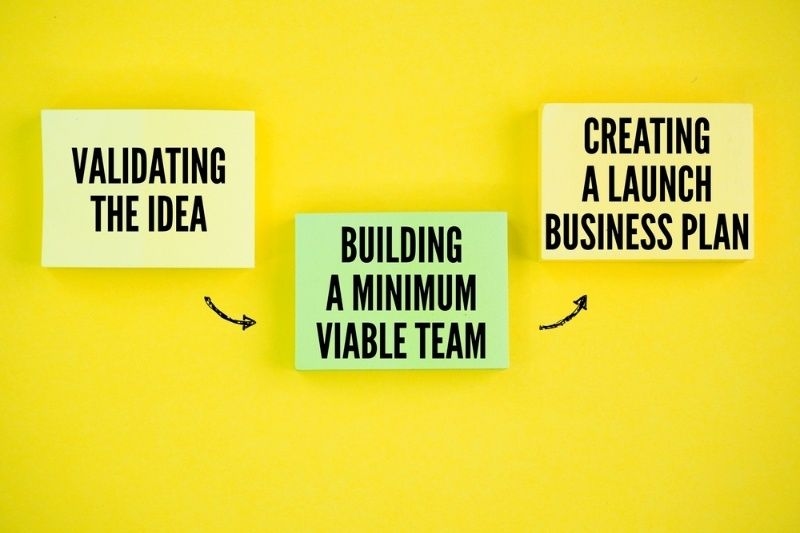
Startup idea validation is essential before launching a business. It provides you with access to the future by learning the exact need and position of your product or services in the market, and here is how to do it step-by-step:
The best startups start with the customer problem. Before creating a solution, make sure you are tackling a real customer problem. Ask yourself:
Uber and Airbnb are both successful because they are addressing very real customer frustrations in travel and accommodation.
A good way to check this is through customer interviews. You want to interview between 10 and 20 potential customers. Most entrepreneurs make the mistake of just asking if they "like the idea" and don't dig enough into their specific problems and pain points. Listening carefully to the language your customer uses often generates valuable marketing materials.
When most entrepreneurs discover a new competitor, they often become alarmed. But competition proves that there's a market. So take your time to research all existing competitors. Pay attention to:
This is valuable information for helping you differentiate yourself from existing solutions. For instance, if people have many complaints about slow customer service and a complicated product UI, that gives your startup an opportunity to be the faster, simpler alternative. Validation is not proving that your solution is unique but proving that there are people to buy it and showing them why your solution is better.
One of the easiest and quickest ways to test your business idea is with an inexpensive landing page. Use the page to:
Creating such pages should take no more than 1 day and could be done with platforms such as Carrd, Webflow, or Landing.com. If you get people to put their email addresses and information on your waiting list, that's a very strong validation signal.
If you have an MVP that performs only the core function of your solution, you won't waste too many resources developing your product when you don't yet know what people want. An MVP is essentially the most basic functional version of your solution that still satisfies early adopters. It could be as simple as a basic landing page, a tool built to address just one major customer pain points, or a service delivered offline.
Companies such as Dropbox famously validate business idea demand for their products through a video before they even exist. The goal isn't to build something perfect; it is to have something with which you can start learning.
Your idea might be incredibly interesting to others, but they won’t pay you money for it. One of the most important parts of testing is determining whether you can make money from it. This is what is called payment validation. How do we test willingness to pay?
Paying for a product or service is a very strong validation signal, and even with a few clients, it shows that your solution has real commercial potential. Harvard Business School says that businesses that monetize early can develop their strategies more effectively as they continue to grow.
There are thousands of customers online and millions of discussions, conversations, and communities that you can leverage for testing your low-cost business idea. Reddit communities for specific industries, social media platforms such as LinkedIn and Facebook groups, and even niche online forums such as Product Hunt. Use the platforms to:
Customer behavior in these forums will show you a lot more about your market than simple survey responses ever could. Companies developing AI-related services are also leveraging platforms such as drgptmd.com to integrate AI-powered solutions into their research, workflows, and customer service.
The problem and solution have been validated; customers want it, but is the market large enough to support scaling your business and growth? This depends on your industry, where you are positioned, and other factors. You must investigate industry reports, search for demand data, examine consumer spending habits, etc. For example, the global AI software market alone is estimated to grow to well over 1 trillion dollars by 2030, according to several analyst firms, making it clear for new businesses in this sector to potentially expand quickly.
A validated startup has two main factors working in its favor.
Validation doesn't require completely eliminating risk, but it should help you to make well-informed choices before investing all your capital. The most successful founders spend considerable time validating ideas before going all-in. They are busy discovering customer needs, testing hypotheses, analyzing competitors, and gathering as much information from the customer as possible. Today, startup ideas gain and lose traction more quickly, and this is why validated businesses, especially tech businesses, find that learning by doing can be much more successful.
Every step of the validation process, from landing page testing to MVP deployment and market size investigation, lays stronger foundations and reduces waste. The greatest takeaway of business validation? Never rely on the idea that your business idea is revolutionary and that people will surely want it; validation will provide you with the necessary insight into whether a real customer wants to buy.
Startup validation can take anywhere from several weeks to several months, depending on the complexity of the idea and the validation methods employed. Simple ideas and methods (e.g., surveys, landing page tests) may yield results more quickly. In contrast, a technical, complex idea will likely require extensive testing and research before any capital is invested. Validation is about gathering enough data before launch, rather than completing it within the shortest possible period.
Entrepreneurs will make the mistake of asking only friends and family. While their support will be there, friends and family may not offer truthful feedback like a paying customer. Another common mistake is for founders to build a product completely without knowing if there is a market for it. Smart founders validate market need and demand, then begin building the product or service.
A startup can, but it's significantly harder to build a successful product without an MVP. An MVP helps gather user feedback as soon as possible, with minimal risk and development cost, without building an overly complex product nobody needs or wants. Service companies may find that introductory pilot services or less comprehensive offers can serve as an MVP.
This content was created by AI